When Urgency Becomes the Job
Urgency is one of the most reliable tools in nonprofit leadership.
It helps work move.
It speeds decisions.
It keeps momentum alive when resources are thin and expectations are high.
For a long time, urgency feels like competence.
Until it quietly becomes the job.
Most senior nonprofit leaders don’t experience urgency as occasional pressure.
They experience it as a background condition.
Projects move faster than calendars.
Decisions arrive before clarity.
Availability fills the gaps where structure hasn’t caught up.
Over time, the work stretches beyond the standard week—not because leaders are inefficient, but because urgency is doing more than moving tasks forward. It’s compensating.
When you look at how senior nonprofit leaders actually spend their time, a pattern appears:
The role doesn’t stop at forty hours.
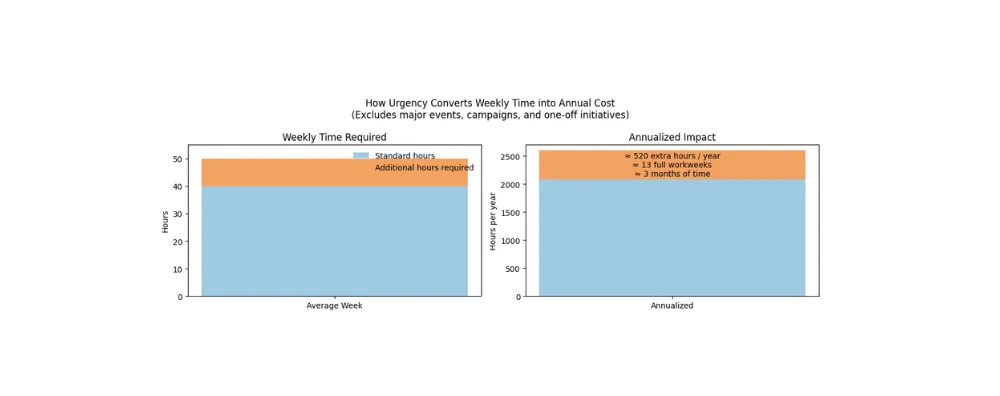
Many leaders report working the equivalent of ten additional hours per week beyond the standard workweek just to keep things moving.
That doesn’t sound dramatic—until you project it forward.
Ten extra hours per week becomes:
520 hours per year
13 full workweeks
More than three months of additional time
And that estimate doesn’t include major events, public-facing obligations, campaigns, or one-off initiatives. It reflects the baseline cost of keeping the system running.
Why does urgency expand instead of resolving?
Urgency is rarely the problem leaders think it is.
It doesn’t persist because people are careless or uncommitted.
It persists because it works—especially in systems where:
Decision authority isn’t fully clear
Roles overlap under pressure
Capacity is assumed rather than designed
In those conditions, urgency becomes a substitute for structure.
It fills in.
It smooths over.
It keeps things from breaking.
But it also quietly transfers time from nights, weekends, and personal life into the organization—without ever being named as such.
There’s a subtle shift many leaders recognize before they can explain it:
Urgency no longer creates relief.
It just creates more urgency.
Work moves, but the volume doesn’t decrease.
Responsiveness generates more demand.
Availability becomes expected rather than appreciated.
At that point, urgency stops being a tactic and starts functioning as infrastructure.
Look at it in a different way...
This isn’t a call to slow down.
And it isn’t a conversation about stress, burnout, or balance.
It’s a question of design.
When urgency accounts for months of time each year, it’s no longer just about pace. It’s about how the system is built—and who it relies on to keep it moving.
In future posts, I’ll explore what happens when leaders begin to interrupt urgency—not to disengage, but to see what it’s compensating for.
Because once the cost is visible, the conversation changes.